Shields parameter
The Shields parameter is a hydro-sedimentary parameter.
It is defined by the following formula:
where:
\(\theta\) is the Shields parameter,
\(\tau\) is the shear stress exerted by water on the river bed,
\(\tau_c\) is the critical shear stress, i.e. the minimum shear stress required to initiate sediment motion.
The Shields parameter is used to assess the stability of sediments in a watercourse. It determines whether the hydraulic conditions are sufficient to set sediment particles in motion. A \(\theta\) greater than 1 indicates that conditions are sufficient to initiate sediment motion, while a \(\theta\) less than 1 indicates that they are not.
The Shields diagram
The Shields diagram is a graph that represents the Shields parameter as a function of the Reynolds number and the Froude number. It is used to visualize the hydraulic conditions in a watercourse and to assess sediment stability.
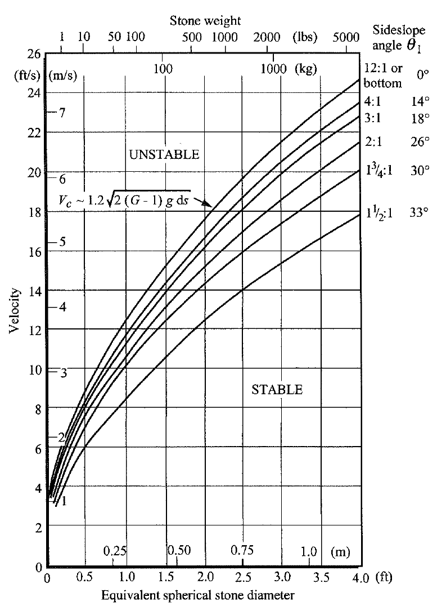
Source: Van Rijn (1984), Sediment Transport, Part I: Bed Load Transport, Journal of Hydraulic Engineering, ASCE, 110(10):1431-1456.
Python implementation
In the wolfhece package, tools are available through the pyshields module to compute the Shields parameter and plot the Shields diagram in various forms.
References
Some useful references for further reading:
Yalin, Ferraira da Silva (2001), Fluvial Processes, IAHR Monograph
Fredsoe, Jorgen and Deigaard Rolf. (1992). Mechanics of Coastal Sediment. Sediment Transport. Advanced Series on Ocean Engineering - Vol. 3. World Scientific. Singapore.
Madsen, Ole S., Wood, William. (2002). Sediment Transport Outside the Surf Zone. In: Vincent, L., and Demirbilek, Z. (editors), Coastal Engineering Manual, Part III, Combined wave and current bottom boundary layer flow, Chapter III-6, Engineer Manual 1110-2-1100, U.S. Army Corps of Engineers, Washington, DC.
Nielsen, Peter. (1992). Coastal Bottom Boundary Layers and Sediment Transport. Advanced Series on Ocean Engineering - Vol. 4. World Scientific. Singapore.
Importing modules
[1]:
try:
    required_version = '2.2.30'
    from wolfhece import is_enough
    is_enough(required_version)

    import timeit
    import matplotlib.pyplot as plt

    from wolfhece.pyshields import RHO_SEAWATER, RHO_PUREWATER, RHO_SEDIMENT, get_shields_cr, get_d_cr
    from wolfhece.pyshields import shieldsdia_dim, shieldsdia_dstar, shieldsdia_sadim # routines graphiques
    from wolfhece.pyshields import get_d_cr_susp, get_transport_mode # suspension
except ImportError as e:
    print(f"Import error: {e}")
    print("Please ensure that the wolfhece package is installed and up to date.")
    print(f"Minimal version required: {required_version}")
Critical Shields parameter
Several formulations exist.
The which parameter selects the function via its index in the list [(get_sadim, get_psi_cr), (get_dstar, get_psi_cr2), (get_dstar, get_psi_cr3)]:
which = 0→(get_sadim, get_psi_cr)— referencewhich = 1→(get_dstar, get_psi_cr2)— referencewhich = 2(default) →(get_dstar, get_psi_cr3)— reference: Fluvial Processes, IAHR 2001, pp 6-9
[3]:
print("Default formula  is which == 2 (get_dstar, get_psi_cr3)\n")
for which in [0, 1, 2]:
    res = get_shields_cr(d = 0.2e-3, rho = RHO_PUREWATER, which=which)
    print(f"Result for which = {which}")
    # critical_shear_velocity, tau_cr, xadim_val, psicr
    print(f"Critical shear velocity: {res[0]:.4f} m/s, Tau_cr: {res[1]:.4f} N/m², Xadim_val: {res[2]:.4f}, Psi_cr: {res[3]:.4f}\n")
Default formula  is which == 2 (get_dstar, get_psi_cr3)

Result for which = 0
Critical shear velocity: 0.0128 m/s, Tau_cr: 0.1649 N/m², Xadim_val: 2.8449, Psi_cr: 0.0509

Result for which = 1
Critical shear velocity: 0.0127 m/s, Tau_cr: 0.1606 N/m², Xadim_val: 5.0592, Psi_cr: 0.0496

Result for which = 2
Critical shear velocity: 0.0139 m/s, Tau_cr: 0.1942 N/m², Xadim_val: 5.0592, Psi_cr: 0.0600
Diagrams
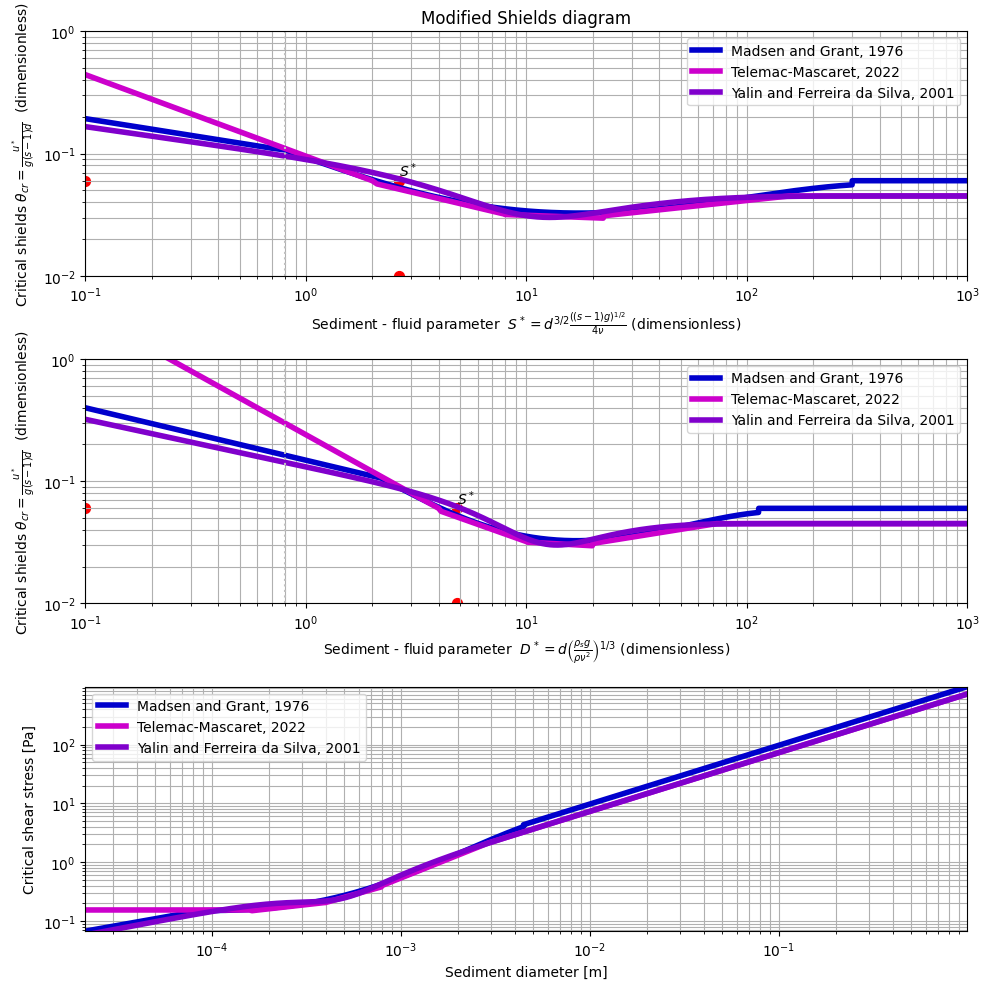
The Shields diagram can be plotted in several forms:
shieldsdia_dstar: Shields parameter vs. dimensionless grain diameter (d*) — dimensionless axesshieldsdia_sadim: Shields parameter vs. dimensionless parameter s_adim — dimensionless axesshieldsdia_dim: Shields parameter vs. hydraulic diameter — dimensional axes
The s_psicr and dstar_psicr arguments allow plotting a specific point on the diagram. They are tuples of the form (value, psicr) where value is the parameter value to plot and psicr is the critical Shields parameter value.
[4]:
fig, ax = plt.subplots(3,1)

s = RHO_SEDIMENT / RHO_PUREWATER # ratio of sediment density to water density
shear_cr, tau_cr, xadim, psi_cr =  get_shields_cr(d = 0.2e-3, rho = RHO_PUREWATER, which = 2)

shieldsdia_sadim(s_psicr=(s,psi_cr), figax=(fig,ax[0]))
shieldsdia_dstar(s_psicr=(s,psi_cr), figax=(fig,ax[1]))
shieldsdia_dim(figax=(fig,ax[2]))

ax[0].set_title('Modified Shields diagram')
fig.set_size_inches(10,10)
fig.tight_layout()
fig.show()
C:\Users\pierre\AppData\Local\Temp\ipykernel_12488\4240051310.py:13: UserWarning: FigureCanvasAgg is non-interactive, and thus cannot be shown
  fig.show()
Determining the critical parameter from the sediment diameter
In this approach, the formula is explicit. This poses no particular difficulty.
Determining the critical sediment diameter from the shear stress
In this approach, the formula is implicit. A numerical method is therefore required to find the critical sediment diameter.
This is implemented in the get_d_cr function, which uses the brenth method by default to find the root. It additionally returns the diameter according to the Izbash formula.
Example with Manning-Strickler
[5]:
dcr_shields, dcr_izbach = get_d_cr(q = 10.,
                                   h = 2.,
                                   K = 25.)

print(f"Critical diameter (Shields): {dcr_shields:.4f} m, Critical diameter (Izbach): {dcr_izbach:.4f} m")
Critical diameter (Shields): 0.4276 m, Critical diameter (Izbach): 0.5363 m
Example with Colebrook-White
It is also possible to compute the critical sediment diameter as a function of the shear stress and a roughness height to be used in the Colebrook-White formula.
[6]:
dcr_shields, dcr_izbach = get_d_cr(q = 10.,
                                   h = 2.,
                                   K = 0.05,
                                   friction_law='Colebrook')

print(f"Critical diameter (Shields): {dcr_shields:.4f} m, Critical diameter (Izbach): {dcr_izbach:.4f} m")
Critical diameter (Shields): 0.1396 m, Critical diameter (Izbach): 0.5363 m
Suspension and transport mode
It is also possible to compute:
the critical diameter for 50 % suspension entrainment
the sediment transport mode
Note: currently only the Manning-Strickler friction law is implemented, but extending to others is straightforward.
[7]:
dsusp = get_d_cr_susp(q = 10.,
                      h = 2.,
                      K = 25.,
                      rhom = RHO_SEDIMENT,
                      rho = RHO_PUREWATER)

print(f"Critical diameter for suspension: {dsusp:.4f} m")
Critical diameter for suspension: 0.0152 m
[8]:
from wolfhece.pyshields import BED_LOAD, SUSPENDED_LOAD_100, SUSPENDED_LOAD_50, WASH_LOAD

mode = get_transport_mode(d = 0.2e-3,
                          q = 10.,
                          h = 2.,
                          K = 25.,
                          rhom = RHO_SEDIMENT,
                          rho = RHO_PUREWATER)

if mode == BED_LOAD:
    print("Bed load transport")
elif mode == SUSPENDED_LOAD_100:
    print("Suspended load transport at 100%")
elif mode == SUSPENDED_LOAD_50:
    print("Suspended load transport at 50%")
elif mode == WASH_LOAD:
    print("Wash load transport")
Wash load transport